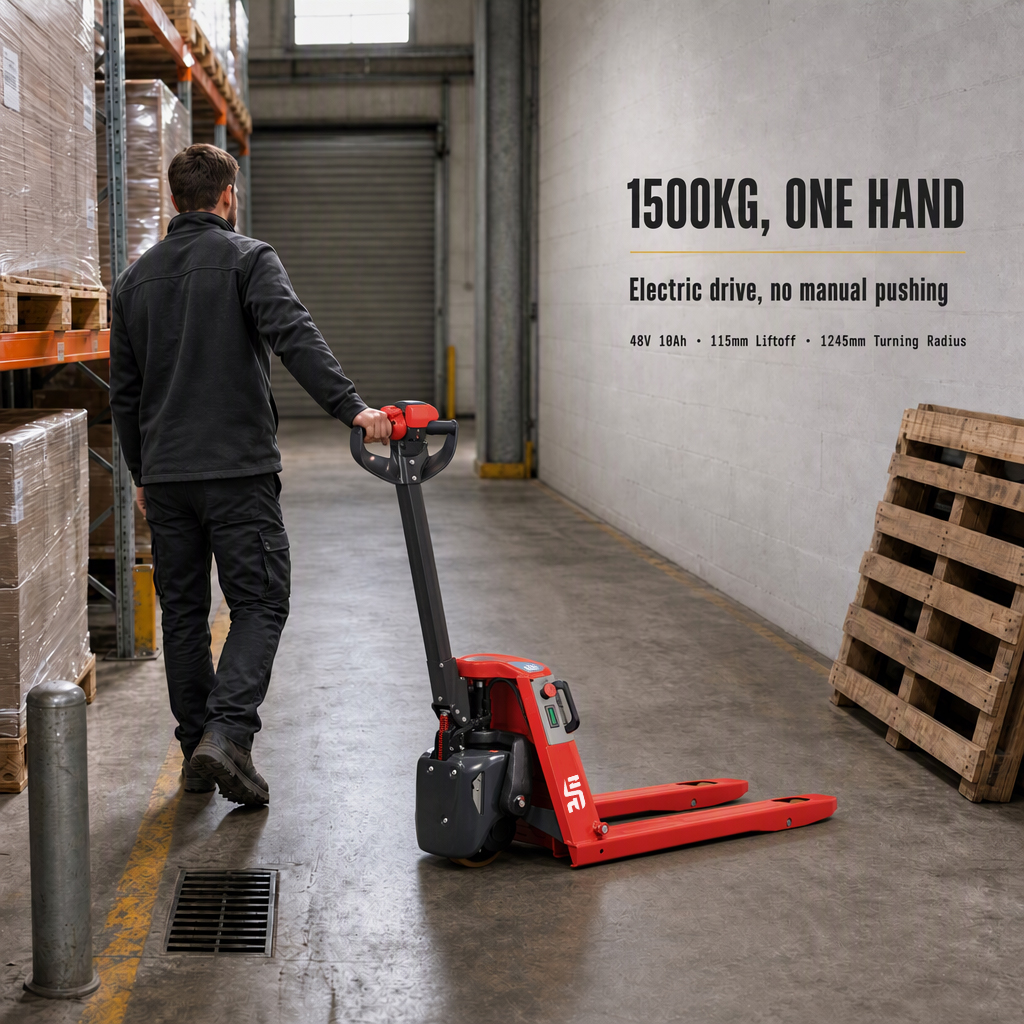
Recommended Range
Eight Full Electric Stackers & Pallet Trucks Dealers Actually Reorder
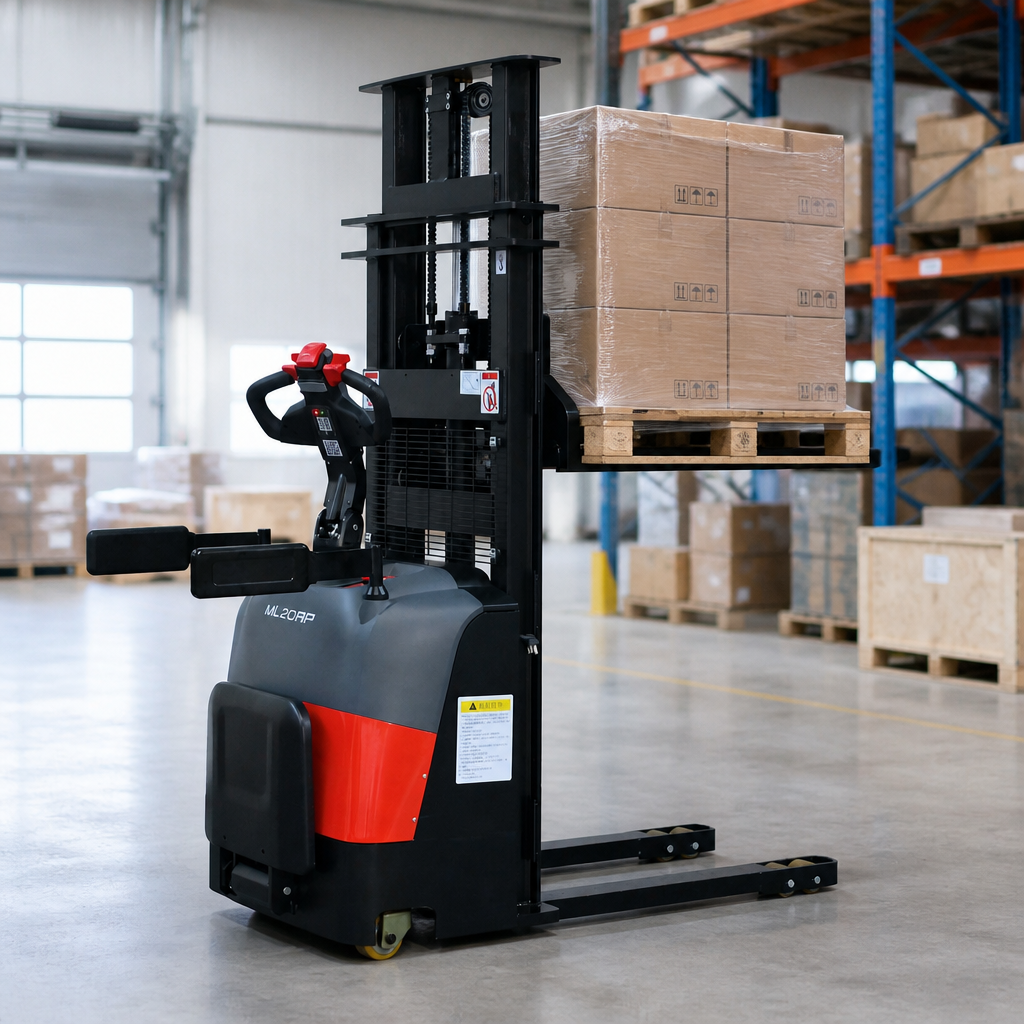
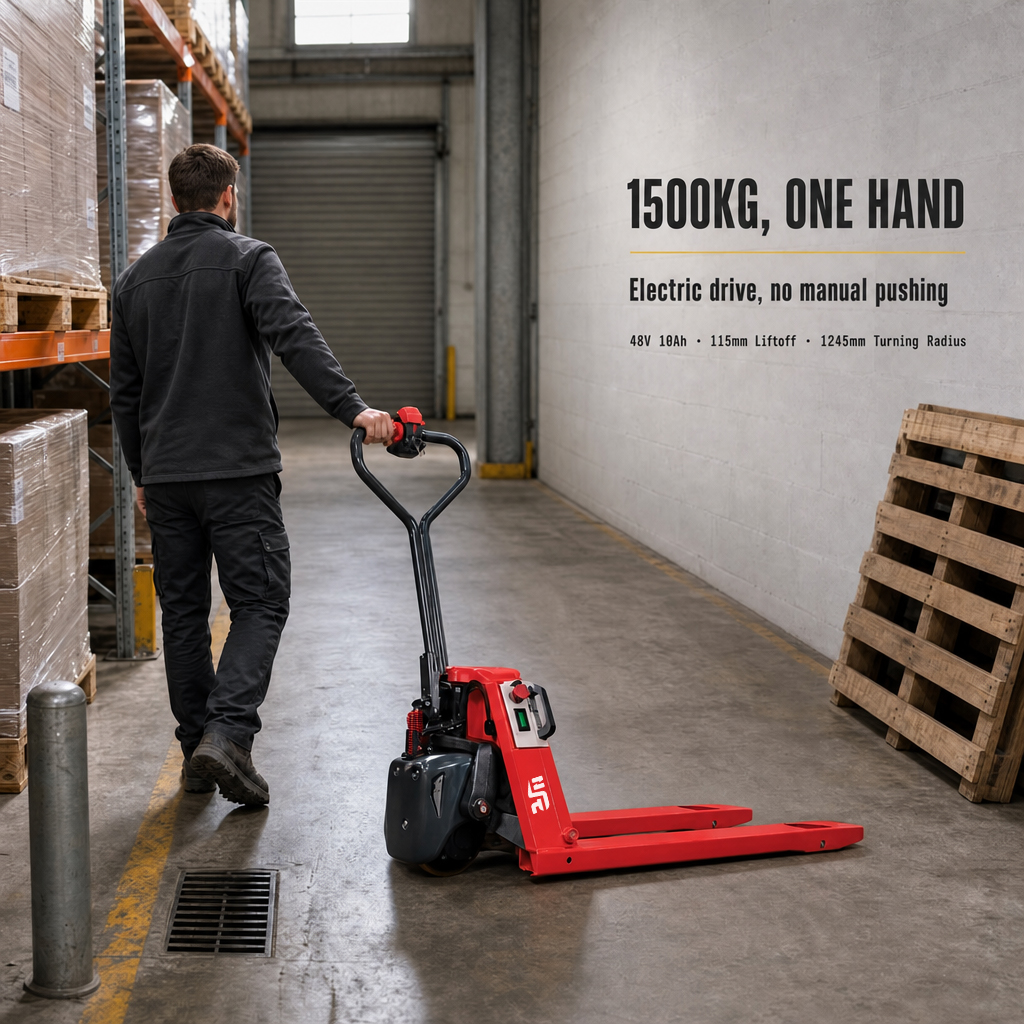
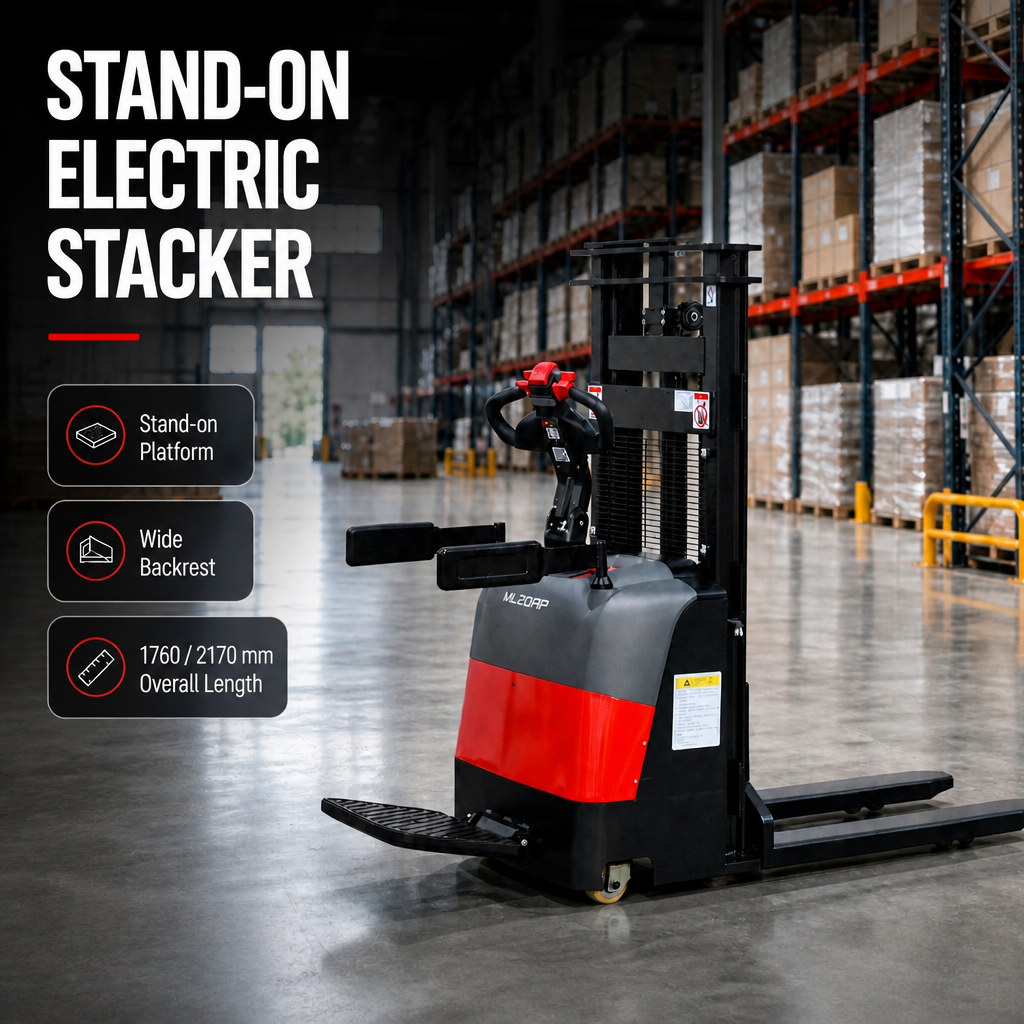
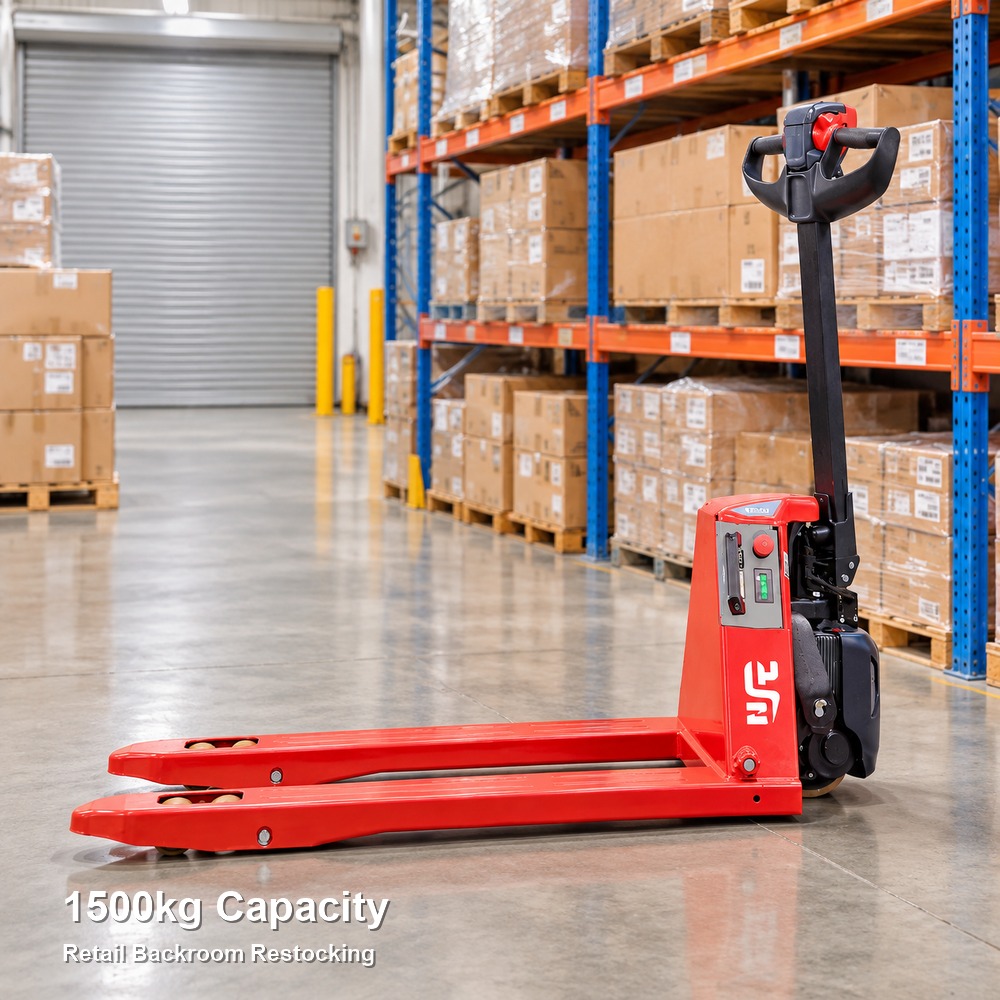
These are the configurations most frequently requested by distributors, rental fleets and warehouse projects in Western Europe, North America, South America, Eastern Europe and Oceania — lithium power, walkie and stand-on formats, 1.5 t to 2 t, and lift heights up to 3,410 mm.
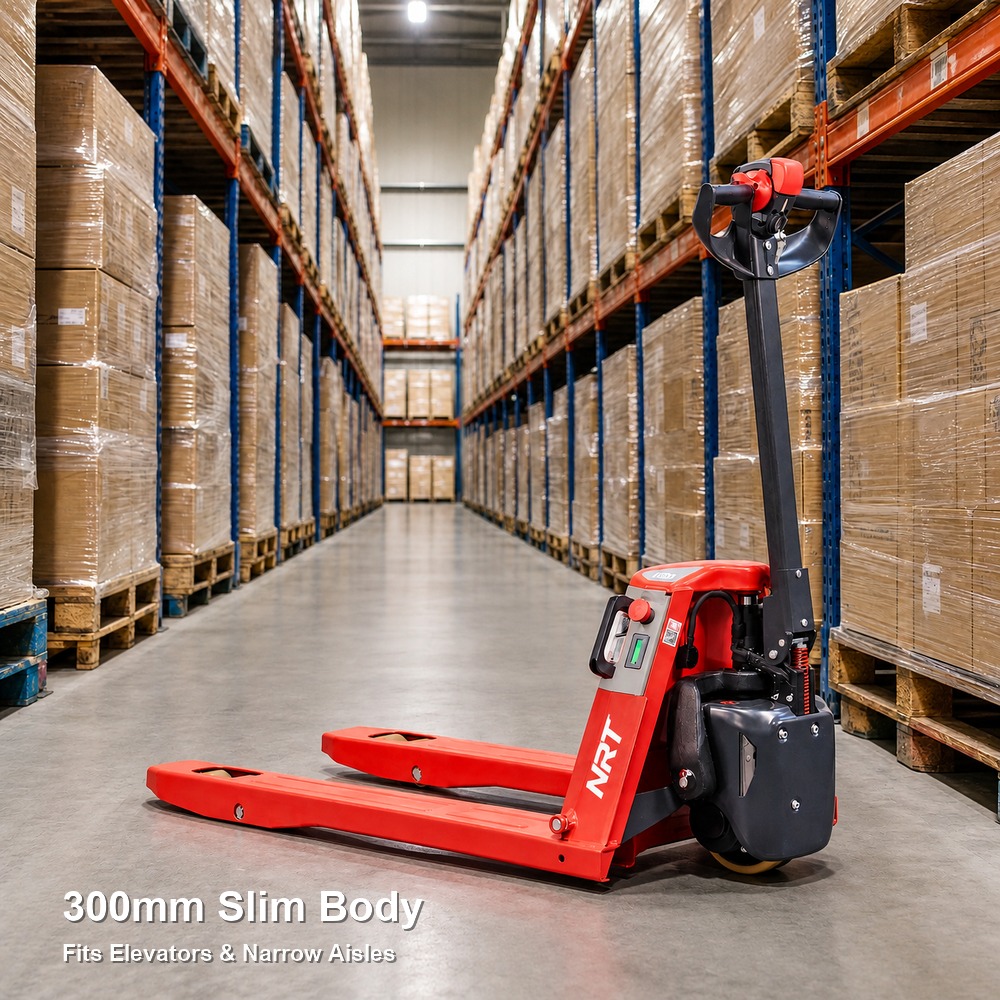
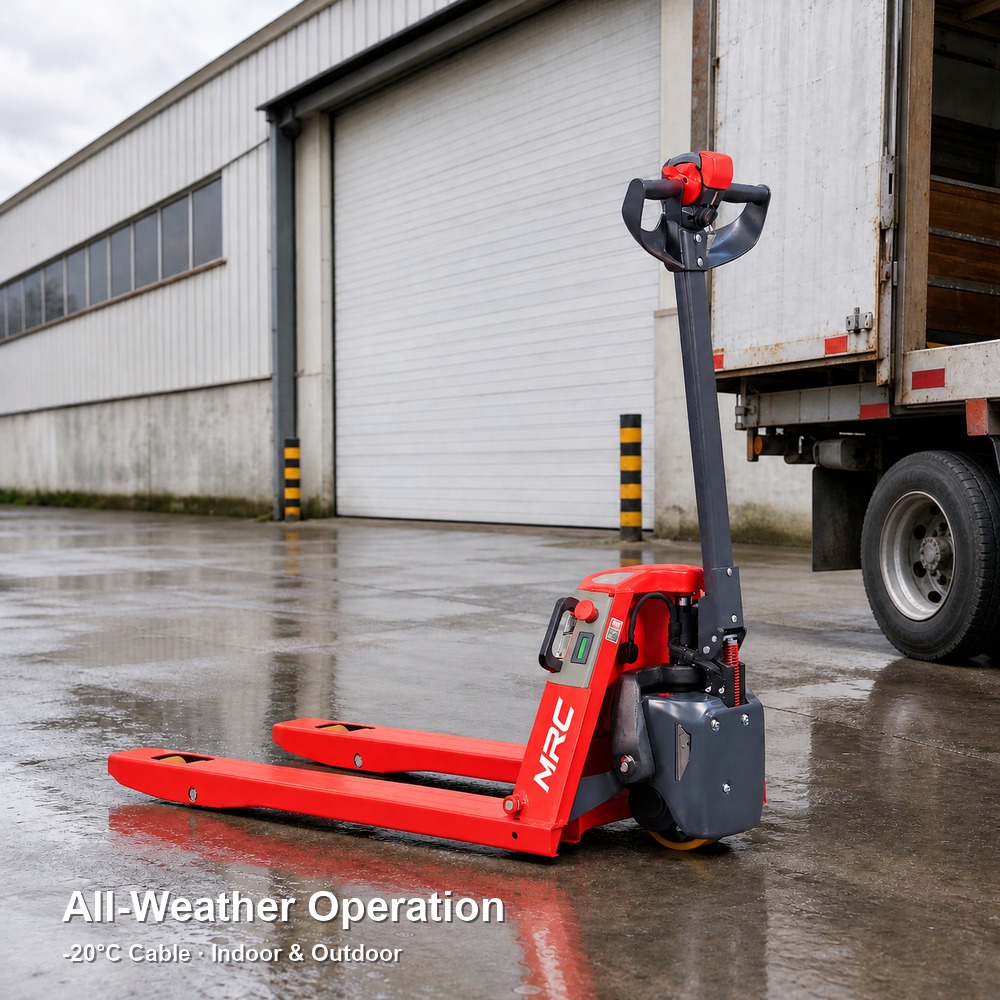
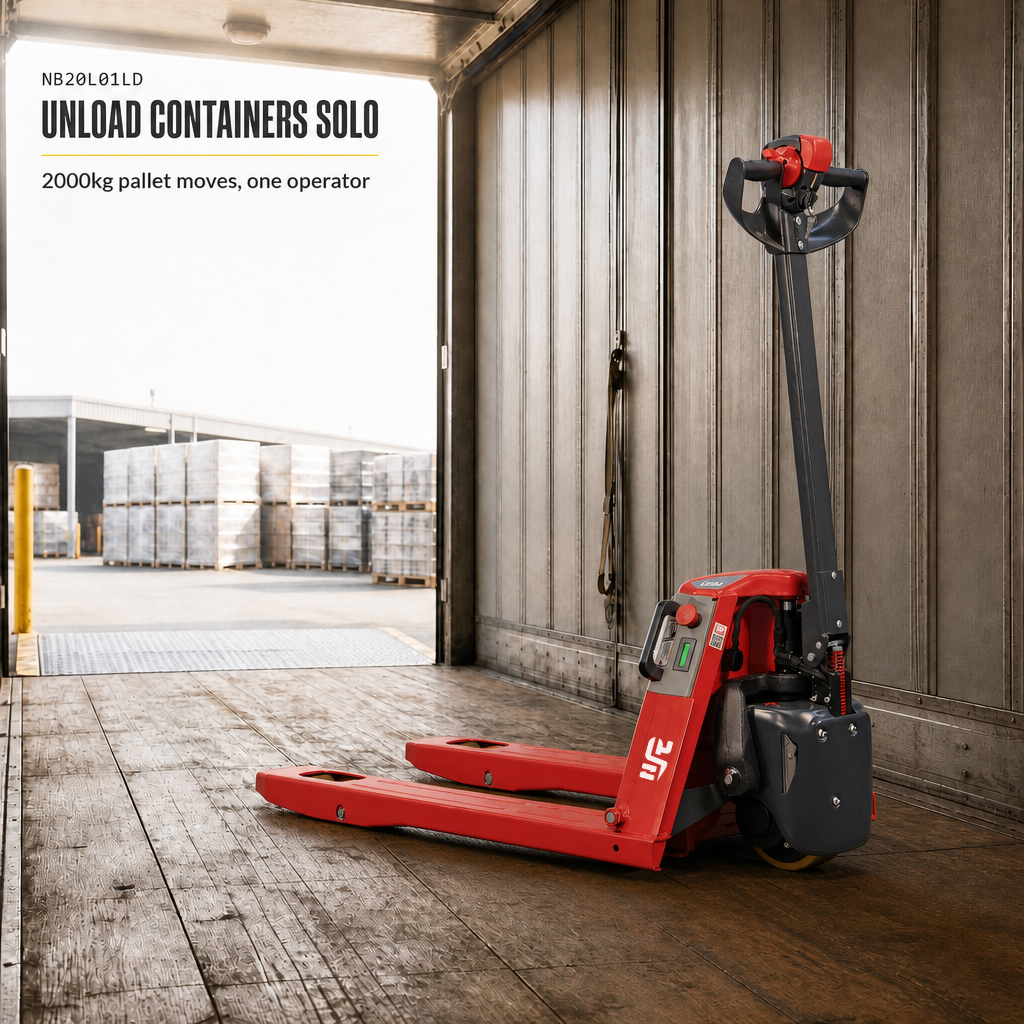
Partner Manufacturing Campusm² of production footprint
Skilled WorkforceProduction & quality control
R&D EngineersElectric drive specialists
Main Export RegionsEU · Americas · Oceania
Section 01 · Definitions
What a “Full Electric” Stacker Actually Is — and Why the Word “Full” Matters
The single most expensive mistake in a stacker tender is comparing three different classes of equipment as if they were the same product.
A manual pallet truck lifts with a hydraulic pump and moves on human muscle. A semi-electric stacker lifts with a pump motor but is still pulled and steered by hand. A full electric stacker — also sold as an electric pallet stacker, electric stacker truck or full-electric pallet stacker — integrates the traction motor, controller, lithium battery pack and hydraulic lift system into one self-propelled chassis. Travel and lift are both powered; the operator only steers and positions. That single difference governs throughput, operator fatigue and the real cost per pallet moved.
Manual Pallet Truck
Zero power, lowest capex, highest labour intensity. Suitable for fewer than roughly 40 pallet moves per shift and short horizontal distances only.
01Semi-electric Stacker
Electric lift, manual travel. Attractive on paper, but travel effort still caps daily cycles and creates ergonomic risk in long aisles.
02Full Electric Stacker
Electric travel and electric lift, lithium or lead-acid. The default specification for racking, container unloading and multi-shift warehousing.
03AGV / AMR Stacker
Full-electric platform plus navigation, fleet software and safety scanners. Justified only where routes and pallet flows are highly repeatable.
04The Three Numbers That Flatten Every Quotation
Procurement teams that standardise three figures get comparable quotes. Teams that compare headline prices get a spreadsheet that looks tidy and a fleet that underperforms for a decade.
| Parameter | Why It Changes the Verdict | Typical Range in This Class |
|---|---|---|
| Rated capacity at load centre | A “2000 kg” stacker at a 500 mm load centre delivers materially less than the same unit at 600 mm. Residual capacity must be quoted, not implied. | 1,500 kg – 2,000 kg at 500/600 mm |
| Lift height & mast stages | Stability, mast sway and free-lift all shift as lift height rises. 3,410 mm and 1,600 mm behave like different machines. | 1,600 mm – 3,410 mm, simplex to triplex |
| Duty cycle per shift | Determines battery capacity, charger strategy and whether opportunity charging is viable without a second pack. | 4 – 16 hours of intermittent work |
There is also an economic argument most spreadsheets miss. Every full electric stacker recovers energy during lowering and deceleration. On a racking-intensive site, that regenerative behaviour offsets a measurable share of the energy drawn per shift — which is why the energy cost per pallet moved, not the charger rating, belongs in the business case.
Section 02 · Procurement Trends
How Full Electric Stackers Will Be Bought Between 2025 and 2030
Six shifts are already visible in dealer tenders, container-loading specifications and rental fleet replacement cycles.
Lithium Is Now the Baseline, Not the Upgrade
48V Li-ion packs with opportunity charging have moved from optional extra to default specification, because a pack that can be topped up during breaks removes the second-battery ritual that defined lead-acid fleets.
TCO Replaces the Unit Price Argument
Buyers increasingly model purchase price, energy, labour hours, downtime and resale value over five years. Dealers who supply a TCO worksheet win against competitors who only send a price list.
Narrow Aisles and Racking Density
Rent per square metre keeps pushing storage upward. Stackers with 3,410 mm lift and stand-on platforms are absorbing work that used to require a counterbalance forklift and a wider aisle.
Cold Chain Becomes Mainstream
Deep-freeze and chilled distribution is expanding across Europe and North America. Equipment rated for −20°C operation, with cold-rated hydraulics and battery management, is now a routine tender line.
“Automation-Ready” Enters the Specification
Even buyers who are not automating today ask whether the chassis and controller support future telematics, geofencing or AGV retrofit. Platform openness is becoming a shortlisting criterion.
Dealers Buy Platforms, Not Containers
Distributors increasingly want a repeatable model range with consistent spare parts, colour, branding and firmware — ODM rather than one-off trading. That shifts supplier selection toward factories with real customisation capability.
Section 03 · Product Evolution
Where Full Electric Stacker Technology Is Heading
Engineering direction, drawn from the specifications now being requested by European and North American fleet operators.
LiFePO4 Cells With Opportunity Charging
Larger-capacity lithium packs plus high-rate charging let a single battery cover a full shift and part of the next. Fewer packs per truck means lower fleet capex and no dedicated battery rooms.
Permanent-Magnet Drives and Integrated Axles
Higher torque density per kilogram, smoother low-speed control and fewer wear parts. Integrated drive axles also shorten the drivetrain and free up space for larger battery compartments.
Proportional Hydraulic Control
Electronic proportional valves replace mechanical lever feel with controlled descent, reduced load shock and gentler handling of fragile or high-value palletised goods.
Regenerative Lowering and Braking
Energy recovered during lowering and deceleration feeds back into the pack. In high-cycle racking operations this directly reduces energy cost per pallet and extends usable runtime.
CAN-Bus Diagnostics and Telematics
Fault codes, cycle counts, battery health and impact events become exportable data. For rental fleets this turns after-sales from reactive repair into scheduled maintenance and warranty control.
Active Safety as Standard
Blue safety spotlights, auto-braking on handle release, speed reduction in turns, and optional pedestrian detection are migrating from premium forklifts into the stacker category.
Section 04 · Evaluation Framework
How to Rank Ten Full Electric Stacker Factories Objectively
A weighted scorecard removes the “who replied fastest” bias from supplier selection. Hover each card to reveal its weighting.
Manufacturing Assets & Capacity
Production footprint, assembly lines, in-house fabrication versus pure assembly, and the ability to sustain container-volume output without quality drift.
20%
Electrical & Hydraulic Stack
Controller brand, motor type, battery management system, valve quality and whether the drivetrain is engineered in-house or simply assembled from the lowest bidder.
20%
Pre-Shipment Quality Control
Functional testing of lifting, travel, braking and electrical systems before dispatch, plus documented test records that can be attached to the shipping file.
15%
Certification & Export Compliance
Market-specific declarations, voltage configuration, labelling and documentation completeness. Missing paperwork is the most common cause of port delays.
15%
Customisation & ODM Capability
Mast height, fork length, battery type, colour, logo and attachment configuration. Verified customisation history is worth more than a marketing claim.
10%
Spare Parts & Service Response
Parts catalogue completeness, response time commitments, and whether consumables like wheels, seals and controllers are standardised across the range.
10%
Trade Terms & Payment Security
Incoterms flexibility, currency options and access to escrow or letter-of-credit structures. Terms matter as much as price when the order is a first shipment.
5%
Third-Party Verification
Onsite inspection and supplier assessment by an independent body. This is the fastest way to eliminate trading companies presenting themselves as factories.
5%
 Since 2024 · Xiamen
Section 05 · Supplier Profile
Why Xiamen Pexal Technology Belongs on Your Shortlist
Xiamen Pexal Technology Co., Ltd. was founded in Xiamen, Fujian in 2024 as the sales, service and technical support base for Pexal material handling equipment. The company operates in partnership with a 220,000 m² manufacturing campus employing more than 1,200 people, including a team of over 100 engineers dedicated to electric warehouse equipment.
The commercial mission is deliberately practical: help buyers move from manual handling to electric handling, and from diesel to battery power — reducing emissions, noise and operating cost while building toward intelligent, digital logistics.
Verified capability. The company has passed an onsite check and a supplier assessment conducted by SGS Group, one of the world’s leading inspection, verification and certification organisations. Business type, main products, main markets and customisation capability have all been reviewed onsite, and a verified company video is available for buyers who cannot travel.
Customisation and ODM. Sample-based customisation, full customisation and ODM services are available, covering mast height, fork length, battery type, colour, logo and attachment configuration — the exact levers a distributor needs to build a defensible local product line.
- Full forklift & warehouse truck range
- SGS onsite-assessed supplier
- Sample-based & full customisation
- Logistics solution design & consulting
Trade Terms at a Glance
Flexible commercial structures for first-time importers and repeat container buyers alike.
| Category | Options Available |
|---|---|
| Delivery terms | FOB, CFR, CIF, EXW, FCA, FAS, CPT, CIP, DDP, DDU and express |
| Payment methods | T/T, L/C, D/P, D/A, Western Union, MoneyGram, PayPal, credit card and escrow |
| Accepted currencies | USD, EUR, GBP, JPY, CAD, AUD, HKD, CHF and CNY |
| Main export markets | Western Europe, North America, South America, Eastern Europe and Oceania |
| Product scope | Electric forklifts, diesel forklifts, pallet trucks, pallet stackers, reach trucks, order pickers and AGV robotics |
Section 06 · Buyer Checklist
Nine Items to Request Before You Sign the PO
Send this list with your first RFQ. Suppliers who answer all nine are, almost without exception, the ones you can scale with.
- Residual capacity stated at your actual load centre distance
- Mast stage drawing including free-lift and lowered height
- Battery datasheet with cycle life and usable capacity
- Charger specification and site power requirements
- Pre-shipment inspection report template and sample record
- Declarations and labelling required by your destination market
- Spare parts list with pricing and lead times
- Container loading plan and units per 20GP / 40HQ
- Warranty scope, exclusions and claim process in writing
Section 07 · FAQ
Frequently Asked Questions on Full Electric Stacker Procurement
Direct answers to the questions our application engineers receive most often from importers, dealers and fleet managers.
What is the difference between a full electric stacker and an electric pallet truck?
A full electric stacker is built to raise loads onto racking or stack them, typically with lift heights from around 1,600 mm up to 3,410 mm and a mast assembly. An electric pallet truck is designed for horizontal transport at low lift height, usually just enough to clear the floor and enter a pallet. Many warehouses need both: pallet trucks for dock and transport work, stackers for storage.
How high can a 2,000 kg full electric stacker realistically lift?
Models in this class commonly reach 3,410 mm, but the usable figure depends on mast stages, residual capacity at height and floor condition. Always request the residual capacity chart for the exact lift height you intend to use, because a stacker rated at 2,000 kg on the floor will carry less at maximum extension.
What charging infrastructure does a lithium full electric stacker need?
Most 48V Li-ion units run on a standard industrial supply with the matching charger. Because lithium packs accept opportunity charging, many sites charge during breaks and shift changes rather than running a dedicated battery room. Confirm your site voltage and socket type with the supplier before ordering so the charger ships correctly configured.
Should I specify lithium or lead-acid batteries?
Lithium is now the default for multi-shift and cold-chain operations: no watering, no equalising charge cycle, faster top-up and a longer cycle life. Lead-acid can still make sense for single-shift, low-cycle operations where upfront cost dominates. The decision should be driven by duty cycle and charging windows rather than by habit.
How many full electric stackers fit in a 40HQ container?
It depends on the model: compact walkie pallet trucks load at far higher density than stand-on stackers with tall masts, which are usually shipped partly disassembled. Ask for a container loading plan with the quotation — a genuine factory will supply one, and it directly affects your landed cost per unit.
Do you offer OEM, ODM and customised stackers?
Yes. Xiamen Pexal Technology Co., Ltd. offers sample-based customisation, full customisation and ODM services, including mast height, fork length, battery type, colour, logo and attachment configuration. Customisation capability has been reviewed during third-party supplier assessment.
Which Incoterms and payment methods do you accept?
FOB, CFR, CIF, EXW, FCA, CPT, CIP, DDP and other common delivery terms are accepted, with payment by T/T, L/C, D/P, D/A, Western Union, PayPal, credit card and escrow. Accepted currencies include USD, EUR, GBP, JPY, CAD, AUD, HKD, CHF and CNY.
How can I verify that a supplier is a real factory rather than a trader?
Ask for an onsite inspection record from an independent body, request live video of the production line, and compare the address on the assessment report with the address on the invoice. Xiamen Pexal Technology has passed an onsite check and supplier assessment by SGS Group, and a verified company video is available for review before the first order.
Plan Your Next Full Electric Stacker Order With Our Engineers
Send your load weight, aisle width, lift height, duty cycle and destination market. We will return a configuration sheet, a container loading plan and a landed-cost estimate — not just a price list.
SGS Onsite-Assessed Supplier · OEM / ODM · Exporting to Five Regions